 Simulation Software for Fluids and Solids
Simulation Electrical Heating Water in Continuous Flow Mode
The simulation of electrical heating of water in a continuous flow mode can be performed with NOGRID points CFD software.
Direct electrical heating of liquids is found in many industrial processes and apparatuses. This case study focuses on the simulation of a continuously operated immersion heater. Devices that provide a constant supply of a heated liquid are often referred to as water heaters, boilers or simply heat exchangers in the case of water.
The immersion heater examined in this study has an electrical resistance heating element enclosed within a container, through which the liquid flows. The heating element is modeled as a separate solid body and is in direct contact with the liquid. Heat is generated due to the electrical resistance of the metal, raising the temperature of the liquid to varying degrees depending on the thickness distribution, geometry, and positioning of the heating element.
Since multiple materials are involved and interact within the simulation, this scenario is also referred to as a multi-phase simulation.


How NOGRID points software handles electrical heating of water
Based on the geometrical model which can either be imported from your CAD or created with our CAD preprocessor COMPASS you can generate a computer model of a specific geometry in a very short time (compared to mesh-based methods) and see its thermal characteristics in advance.
The following equation is used within NOGRID points to solve the electrical potential u in liquids and solids:

u electrical potential u = u (x, y, z)
σ electrical heat conductivity
q source term
In the field of electrostatics, the electrical potential does not change with time and the valid differential equation for the electrical potential u is the Poisson equation

Conduction in solids and liquids is described by Ohm's law, which states that current is proportional to the applied electric field. The current density (current per unit area) j in an area is directly proportional to the electric field E and the proportionality factor is the electric conductivity σ:

The electric field E can be calculated directly from the electric potential u by

In this study, the metal of the heater is treated as a solid, meaning only the temperature equation and the Poission equation for electrical potential are computed. The fluid inside the chamber is of course in contact with the heater, allowing heat exchange between the two. This means the temperature of the fluid is influenced by the heater and vice versa. for example, if the fluid's viscosity is temperature-dependent, the heater's temperature distribution will directly affect the flow behavior within the nozzle.
Heat transfer can occur through conduction, radiation, and/or convection driven by fluid motion. All types of heat transfer mechanisms can be coupled in the simulation. In this example, ideal thermal contact between the nozzle and the fluid is assumed.
Capabilities of NOGRID points CFD software
NOGRID points helps to understand the flow by visualization of the mass, momentum and heat transfer of single and multiple phases. You receive integral quantities which you can use to analyze the heat exchange efficiency. NOGRID unites abilities to handle free surface flow and moving parts in the domain and allows the simulation of any conceivable geometry and operation modes such as
- fully 3D computation solving the complete Navier-Stokes equations
- easy and intuitive setup, including for FSI (Fluid-Structure Interaction) cases
- freely definable material properties by equations or curves
- coupled solutions for electrical heating and fluid mechanic cases
- open or closed domains, including inflow and outflow areas (non-batch mode)
- moving of parts and flexible thermal contact behaviour
Why choose Nogrid?
NOGRID provides professional CFD software for the simulation of fluid flow, heat and mass transfer, and chemical reactions. Its efficient modelling workflow helps engineers analyse flow behaviour, evaluate designs and make informed decisions without creating a conventional volume mesh.
Faster model preparation
With NOGRID, only the geometry boundary needs to be meshed. The finite points inside the fluid domain are generated automatically according to user-defined settings, both at the start of the simulation and during the calculation.
This approach reduces preprocessing effort and makes it easier to prepare complex geometries and cavities for simulation.
Efficient CFD workflow
The modelling process follows four straightforward steps:
Build the geometry. Mesh the boundary. Define the simulation. Start the calculation.
NOGRID is designed to provide short computation times, including for applications involving complex cavities. Engineers can use the resulting data to examine flow distribution and other relevant flow characteristics.
Better insight into fluid-flow processes
CFD solves the fundamental equations governing fluid flow. NOGRID software enables engineers to predict and analyse the behaviour of fluids and related physical processes before or alongside physical testing.
The simulation results can support:
- evaluation and comparison of design alternatives
- optimisation of construction and operating parameters
- improved planning reliability
- reduction of development time and testing effort
- faster progression from design to market or operation
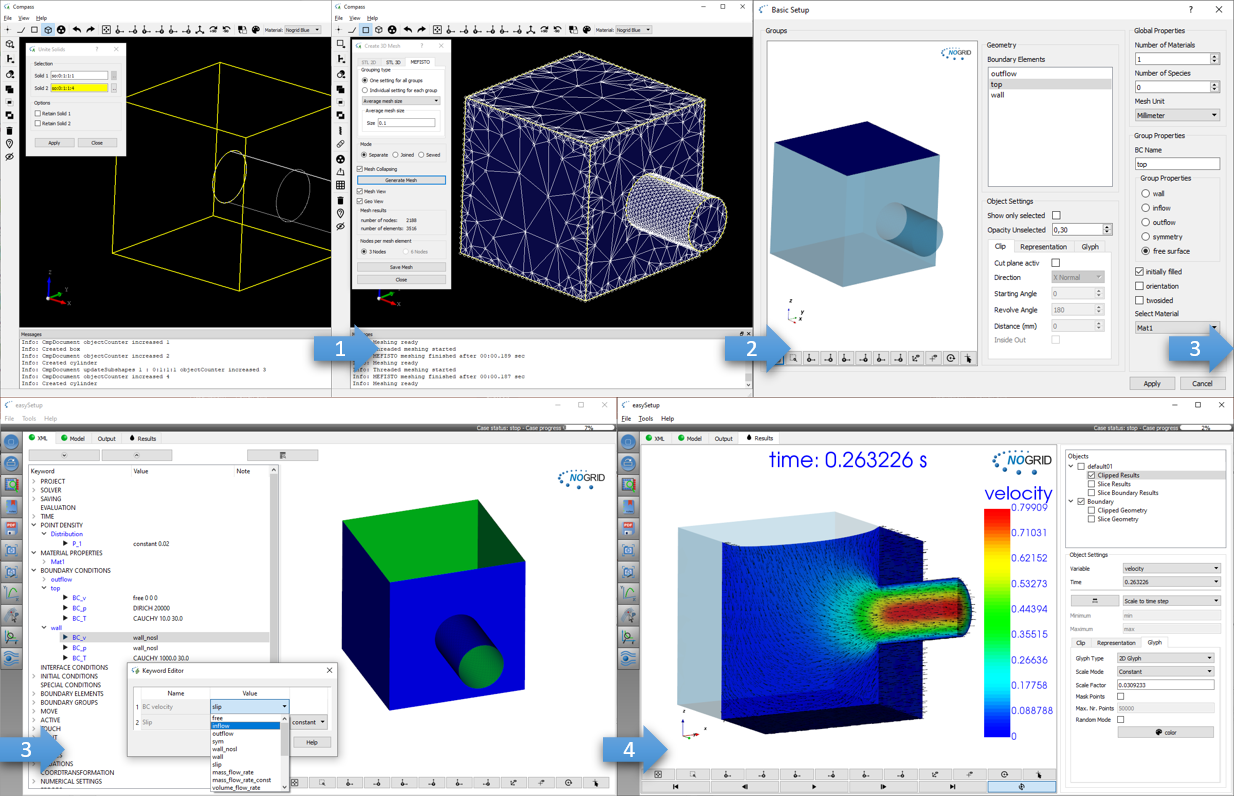
Steps from geometry generation to simulation results
TRAINING
Our two-day training courses teach participants how to set up, run and evaluate simulations efficiently with NOGRID CFD software. The courses include practical guidance for handling different types of simulation cases.
For more details please refer to Training Courses →
Technical Support
Professional support is available from the beginning of your work with NOGRID. Our technical team assists users by telephone and email with software operation, case setup and simulation-related questions.
For more details please refer to Software Support →
Simulation Service
When internal time, expertise or resources are limited, NOGRID can support your project with individual numerical simulation services. Our engineers develop and evaluate CFD models based on the specific requirements of your application.
For more details please refer to Software Support →