 Simulation Software for Fluids and Solids
Nogrid's Stress Software
NOGRID pointsStress was developed specifically for the container glass industry and helps engineers analyze their container designs in terms of strength and durability. Different design variants can be compared without time-consuming pyhsical tests. In combination with NOGRID pointsBlow, which provides reliable thickness distributions, design optimization has never been easier or more trustworthy. Even in the early stages of the design process, a created design can be tested as well.
Advantages of simulation with NOGRID pointsStress software:
- Extremely short modeling time due to the fully integration into Nogrid pointsBlow workflow and dramatically reduced computing time for full 3-D cases.
- Direct import of models from other CAD systems via IGES/STEP interface
- Based on standardized stress tests as well as real-life stress cases, the following predefined stress tests are available in NOGRID pointsStress:
1. Internal Pressure
2. Head Load
3. Pendulum Impact
4. Drop Collision
5. Filling Line Collision
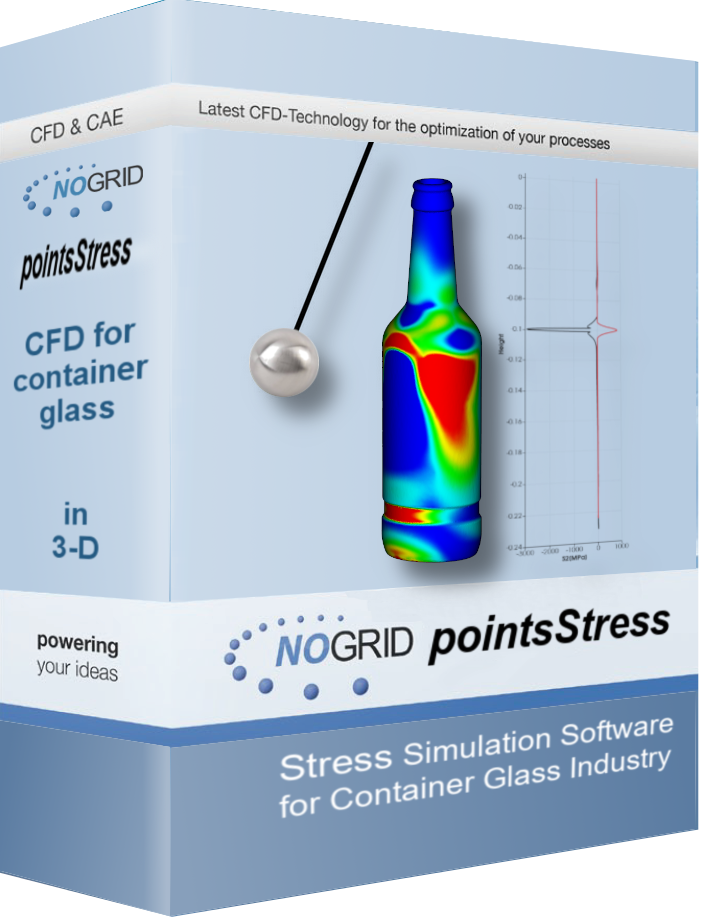
NOGRID pointsStress meshless CFD software product box
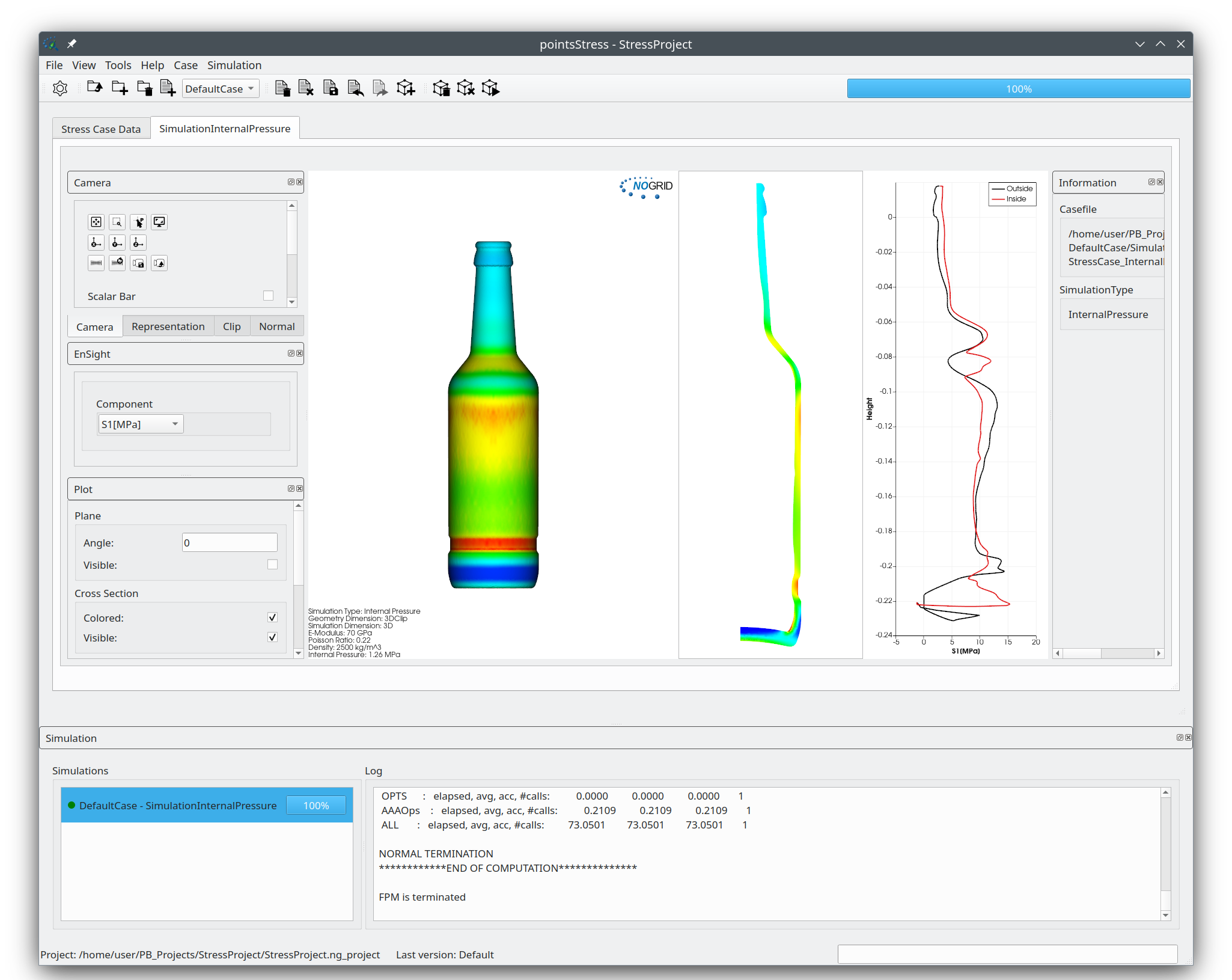
NOGRID pointsStress GUI
Outstandingly short modeling and best practice solutions
Every test case can be computed in full 3D, so there is not limit to the container geometry. If the container is symmetric, the Internal Pressure and the Head Load test cases can be simulated in a reduced model. However, computational time is in every case in the range of some minutes. After finishing a simulation the intuitive user interface presents all the necessary stress information as colored 3D model and line plot across the height, both highly adjustable.
Stress tests
- Internal Pressure
Sparkling wine, champagne or carbonated water will lead to pressure on the inside of a glass container. In this stress case a constant pressure will be applied to the inner surface of the bottle. Due to the strengths of our solver, it is not necessary to fix any region. Stress peaks at the bottom are avoided, and the calculated stresses arise solely as a result of the internal pressure.
- Head Load
Packaging might apply extensive forces to the head of a glass container. For determining where the container experiences the most stress under a force from the top, the Head Load stress test is to be used. Nogrid pointsStress detects the top surface of the head, on which a constant force is employed. Internally the force is transformed into a stress boundary condition on the detected surface.
In contrast to the Internal Pressure stress test, the bottom surface of the bottle is detected and held fixed. A small slip at the bottom is allowed in order to avoid nonphysical stress peaks.
- Pendulum
The Pendulum stress test is based on the DIN standard 52295 and simulates the dynamic impact of a pendulum. However, all parameters such as pendulum radius, pendulum mass, pendulum length, and others can be specified. The resulting impact velocity and impact energy are determined and displayed according to the given inputs. The container is in contact with the bottom plate and the V-shaped support opened by 120°, just as in real experiments. Since this test case is always three-dimensional, any desired impact point can be defined by rotating the bottle.
- Drop Collision
The same simulation technique as for the Pendulum stress test is employed for the Drop Collision stress test. The bottom on which the bottle impacts is assumed to be stiff. However, a proportion of the potential energy is transformed into rotational energy during the impact. The bottle may be oriented at any desired impact angle. The impact energy is calculated from the specified drop height and the specified bottle density.
- Filling Line Collision
During the filling process, the containers are transported at a certain speed on a conveyor belt. Occasionally, the bottles may collide with each other or impact an inclined wall. This scenario is represented by the Filling Line Collision stress test.
The impact location is determined automatically, as it corresponds to the container’s point of maximum radius and the angle of the inclined wall. For non-round containers, the rotation around the central axis can be adjusted, allowing the user to change the impact point.