 Simulation Software for Fluids and Solids
Simulation Quartz Glass Sagging

Figure 1: Animation quartz glass sagging
The simulation of quartz glass sagging can perfectly be performed with our CFD software NOGRID points. It enables engineers to model the sagging behaviour of quartz glass with high accuracy.
Fused Silica (SiO2) is a synthetic molten, amorphous quartz glass. Quartz glass has an extraordinarily high optical transmissivity for ultraviolet light. Due to its low coefficient of thermal expansion, quartz glass can withstand very high operating temperatures. The very good UV-light transparency of quartz glass cannot be outperformed by any other industrial glass material. Quartz glass components and fused silica optics are made of large silica glass blocks, called quartz glass "boules". This raw fused quartz glass material can be sawn, ground, polished and shaped according to customers specifications.
Simulation Quartz Glass Sagging with NOGRID points
Here we present a simulation, computed by our meshless CFD software NOGRID points, where a quartz glass cylinder is formed in an oven under its dead weight.
Quartz glass is most commonly heated in an oven and 'sagging' it over a form or into a mold. The glass is heated up slowly to avoid thermal shock. Approximately at the sagging temperature the quartz glass will begin to soften and appear glossy. Depending on the required process time sagging occurs at 100 °C to 300 °C above the sagging temperature. Once the quartz glass has sagged to the final state or the quartz glass has achieved the desired form the heat is quickly vented and the temperature is reduced to prevent further movement of the quartz glass and then it is stabilized at its respective annealing temperature and annealed.
It is also possible to simulate a forming process using different tools to accelerate the forming time.
Capabilities of NOGRID points CFD software
NOGRID unites the capabilities to handle free surface-flow and moving parts within the domain, allowing the simulation of any conceivable geometry and operating mode, such as
- fully 3D computation solving the complete Navier-Stokes equations
- easy and intuitive setup
- freely definable material properties by equations or curves, also for non-Newtonian fluids
- evaluation of chemical reactions and corresponding heat source terms
- open or closed domains, including inflow and outflow areas (non-batch mode)
- moving of parts
Why choose Nogrid?
NOGRID provides professional CFD software for the simulation of fluid flow, heat and mass transfer, and chemical reactions. Its efficient modelling workflow helps engineers analyse flow behaviour, evaluate designs and make informed decisions without creating a conventional volume mesh.
Faster model preparation
With NOGRID, only the geometry boundary needs to be meshed. The finite points inside the fluid domain are generated automatically according to user-defined settings, both at the start of the simulation and during the calculation.
This approach reduces preprocessing effort and makes it easier to prepare complex geometries and cavities for simulation.
Efficient CFD workflow
The modelling process follows four straightforward steps:
Build the geometry. Mesh the boundary. Define the simulation. Start the calculation.
NOGRID is designed to provide short computation times, including for applications involving complex cavities. Engineers can use the resulting data to examine flow distribution and other relevant flow characteristics.
Better insight into fluid-flow processes
CFD solves the fundamental equations governing fluid flow. NOGRID software enables engineers to predict and analyse the behaviour of fluids and related physical processes before or alongside physical testing.
The simulation results can support:
- evaluation and comparison of design alternatives
- optimisation of construction and operating parameters
- improved planning reliability
- reduction of development time and testing effort
- faster progression from design to market or operation
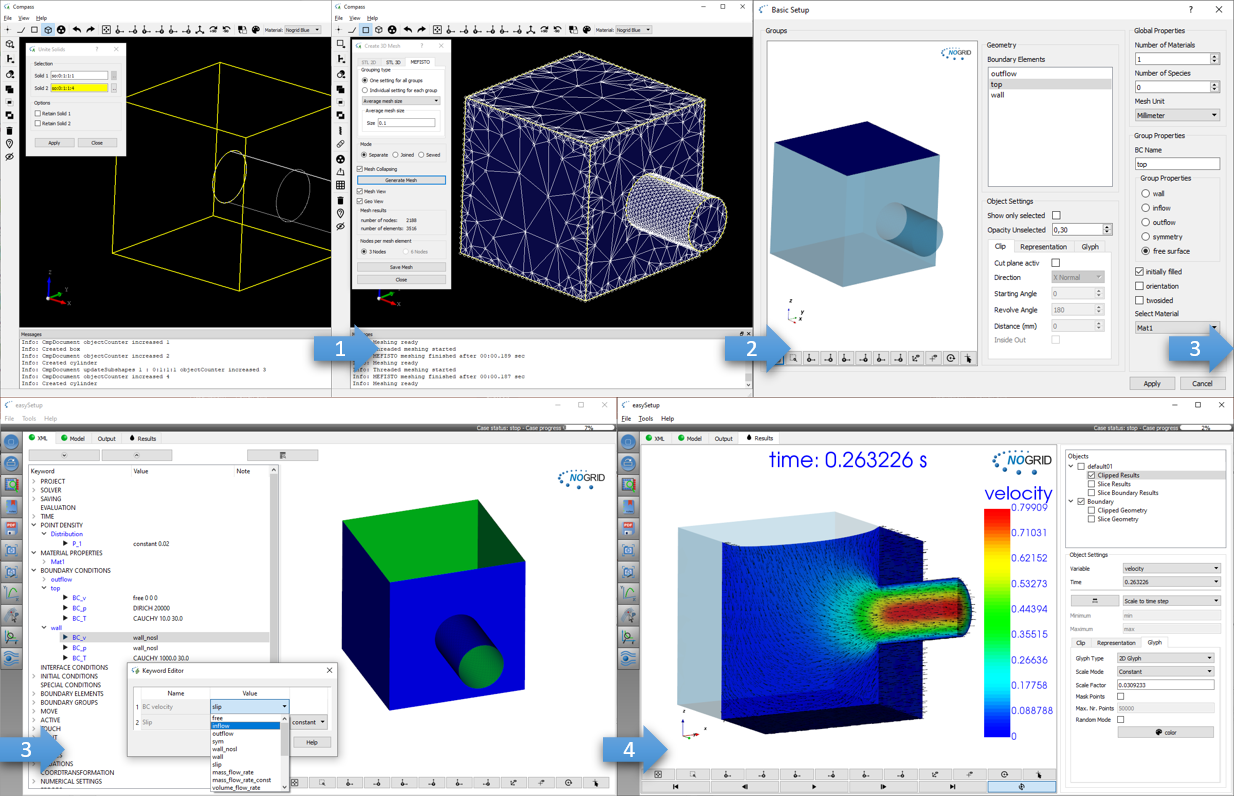
Steps from geometry generation to simulation results
TRAINING
Our two-day training courses teach participants how to set up, run and evaluate simulations efficiently with NOGRID CFD software. The courses include practical guidance for handling different types of simulation cases.
For more details please refer to Training Courses →
Technical Support
Professional support is available from the beginning of your work with NOGRID. Our technical team assists users by telephone and email with software operation, case setup and simulation-related questions.
For more details please refer to Software Support →
Simulation Service
When internal time, expertise or resources are limited, NOGRID can support your project with individual numerical simulation services. Our engineers develop and evaluate CFD models based on the specific requirements of your application.
For more details please refer to Software Support →