 Simulation Software for Fluids and Solids
Simulation Glass Pressing


NOGRID's glass pressing simulation enables in-depth analysis and optimization of the glass pressing process. This method is used to manufacture a wide variety of products, including lenses, dishes, ashtrays, drinking glasses, bowls, sinks, bottles, and containers (using the press- and blow process).
The market constantly demands thinner container walls, lighter objects and improved surface textures making glass production far more complex than the seemingly simple nature of the final products suggests.
NOGRID points meshless CFD software has been used successfully for the improvement of the glass pressing process for many years. The combination of free surface deformation under the combined effect of
- the motion of different solid devices (molds, plunger, etc.),
- gravity,
- the cooling process (mainly due to the heat exchange with the mold and the plunger),
- the mechanical and thermal detection of the contact between the deforming glass and the moving parts
create a better understanding of the mechanism of the glass pressing process. This better understanding quickly leads to tremendous savings in manufacturing costs and time while ensuring a final product of high quality.
Glass pressing is likely the application with the highest degree of deformation. As shown in Figure 4, the process starts with a spherical glass sample. During pressing, the solver automatically refines the point cloud wherever needed - typically in areas with extreme deformation or where the mold's fine geometric details demand higher resolution. Intelligent algorithms ensure that the grid is refined automatically, both in 2D and 3D, only where and when necessary throughout the simulation. This adaptive refinement is especially crucial when the final product includes intricate geometrical features.
Glass pressing is primarily constrained by two key factors. If the pressing time is too long, the cold mold or plunger can cause the glass flow to freeze or lead to the formation of chill ripples on the glass surface. Conversely, if the pressing time is too short, the plunger moves at a very high speed, whcih can result in the glass tearing apart.
Simulation of glass pressing with NOGRID points software
Our software can accurately predict these effects, supporting designers in developing optimal geometries for their molds and plungers. In addition to simulating the normal flow behavior based on Newton's law of viscosity, NOGRID points is also capable of handling non-Newtonian materials, including viscoelastic material behavior.
NOGRID combines the capabilities to handle multiphase flows and moving parts within the domain, allowing the simulation of any conceivable geometry and operating mode, such as:
- fully 3D computation solving the complete Navier-Stokes equations
- easy and intuitive setup for FSI (Fluid-Structure Interaction) cases
- freely definable material properties by equations or curves
- moving parts with complex moving features
- open or closed domains including moving of additional parts
- temperature computation for the solid molds included
Follow this link to learn more about how simulation can help with the design of pressed glass.
Why choose Nogrid?
NOGRID provides professional CFD software for the simulation of fluid flow, heat and mass transfer, and chemical reactions. Its efficient modelling workflow helps engineers analyse flow behaviour, evaluate designs and make informed decisions without creating a conventional volume mesh.
Faster model preparation
With NOGRID, only the geometry boundary needs to be meshed. The finite points inside the fluid domain are generated automatically according to user-defined settings, both at the start of the simulation and during the calculation.
This approach reduces preprocessing effort and makes it easier to prepare complex geometries and cavities for simulation.
Efficient CFD workflow
The modelling process follows four straightforward steps:
Build the geometry. Mesh the boundary. Define the simulation. Start the calculation.
NOGRID is designed to provide short computation times, including for applications involving complex cavities. Engineers can use the resulting data to examine flow distribution and other relevant flow characteristics.
Better insight into fluid-flow processes
CFD solves the fundamental equations governing fluid flow. NOGRID software enables engineers to predict and analyse the behaviour of fluids and related physical processes before or alongside physical testing.
The simulation results can support:
- evaluation and comparison of design alternatives
- optimisation of construction and operating parameters
- improved planning reliability
- reduction of development time and testing effort
- faster progression from design to market or operation
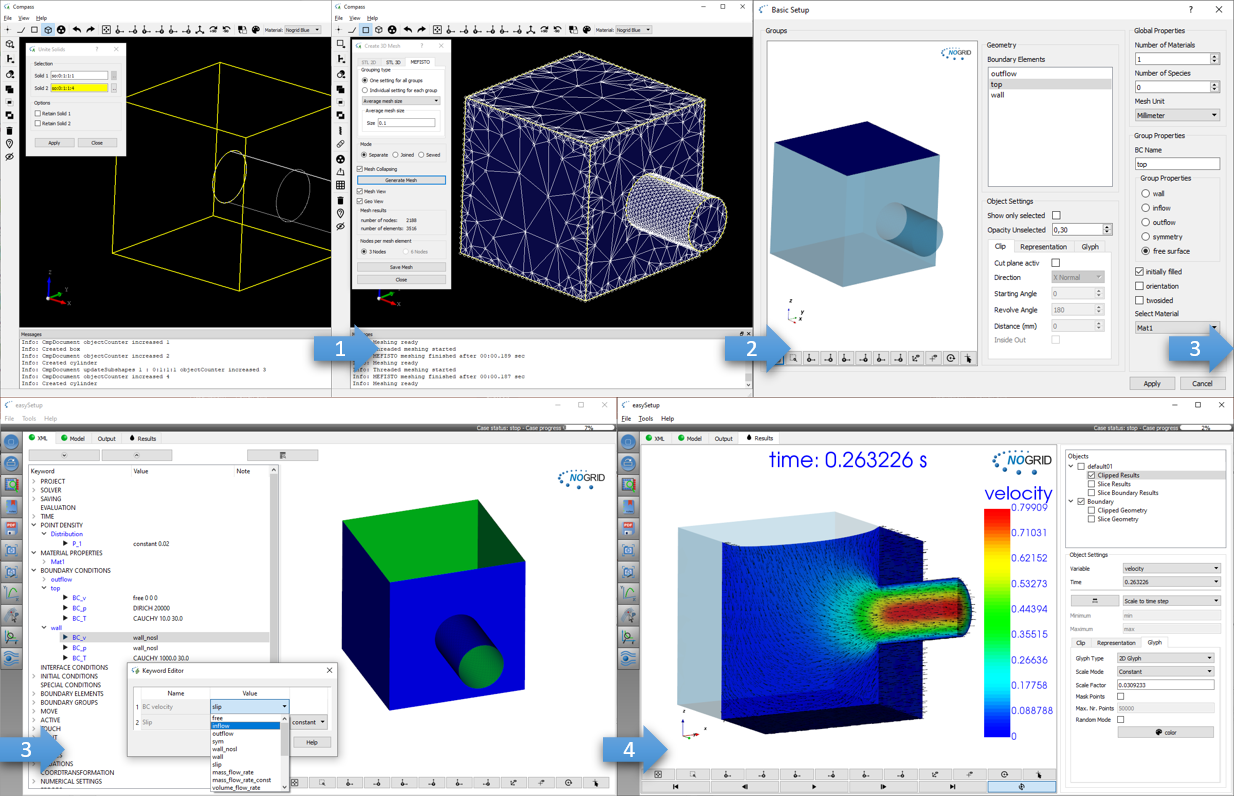
Steps from geometry generation to simulation results
TRAINING
Our two-day training courses teach participants how to set up, run and evaluate simulations efficiently with NOGRID CFD software. The courses include practical guidance for handling different types of simulation cases.
For more details please refer to Training Courses →
Technical Support
Professional support is available from the beginning of your work with NOGRID. Our technical team assists users by telephone and email with software operation, case setup and simulation-related questions.
For more details please refer to Software Support →
Simulation Service
When internal time, expertise or resources are limited, NOGRID can support your project with individual numerical simulation services. Our engineers develop and evaluate CFD models based on the specific requirements of your application.
For more details please refer to Software Support →