 Simulation Software for Fluids and Solids
Simulation Accelerated Boat
The simulation of an accelerated boat can perfectly be performed using NOGRID points CFD software.
Simulation of an accelerated boat is the key to understanding hydrodynamic behavior, pressure distribution, and free surface deformation. NOGRID points CFD software allows engineers and naval architects to model the acceleration process of a boat with high accuracy, helping optimize hull shape, propulsion, and performance.
Challenges of free surfaces in fluid mechanical systems
Free surfaces in fluid mechanical systems are a great challenge for numerical simulation methods in themselves. However, many applications additionally exhibit moving structures interacting with the fluid. In most cases a realistic modeling with today's standard software is simply not feasible or would at least require a non-economical amount of time and computational power to solve every-days' simulation problems. One such example is the simulation of a boat being accelerated until it reaches its final inclination determined by its hull shape and its speed.
A good understanding of this lifting process is mandatory for guiding the design and optimization of the hull. In grid-based methods such simulations are usually more simplified. Instead of allowing the boat moving freely during acceleration, the boat hull is entirely fixed or at most rotation around one axis is possible (thus reducing the degrees of freedom to zero or one), whereas the water flows with the velocity the boat should run with. This technique reduces computation time and numeric imprecision due to remeshing. It also gives a first insight into the fluid mechanical properties of the boat hull. However, it never provides the full information required for an in-depth understanding necessary in the design process. Rotational instabilities of a freely moving boat cannot be analyzed to name just one challenge.


Modeling abilities of NOGRID points
In contrast NOGRID points software, a meshless CFD (computational fluid dynamics) software permits several approaches for modeling the described scenario realistically. No restrictions on the movability of the boat are prescribed. In particular all six degrees of freedom, three for the velocity and three for the rotation of the rigid boat hull, are available. In the approach presented here the boat rests in a box partly filled with water. The boat hull is modeled as a set of faces which can freely move in the water. The fluid-structure interaction of the water with these faces is further determined by the center of gravity of the boat, by its mass and by its inertial tensor. Beginning at time t=0 an outer force and (small) torque is applied to the center of gravity (generated by the thrust of the propellers), and which now starts to accelerate the boat.
The simulated time is 20 seconds, the computation time of the simulation (done on a normal desktop computer equipped with a quad core processor) was about 5 hours. NOGRID points provides the means for economical support design and development in engineering, both drastically reducing time spent on preprocessing as well as computation time.
Capabilities of NOGRID points CFD software
NOGRID points combines the capabilities to handle multi-phase flows and allows the simulation of any conceivable geometry and operating mode, such as
- fully 3D computation solving complete Navier-Stokes equations
- easy and intuitive setup for multiphase flow cases
- freely definable material properties by equations or curves for each fluid
- large geometries with small gaps or holes
- open or closed domains, including moving of additional parts
- any material combination for the fluids
The role of finite points in NOGRID points
In NOGRID points finite points assume the role of the mesh used in FEM or FVM based methods. Beside the physical parameters of the model the user only has to determine the approximate density of these finite points. Tedious meshing and inaccurate and inefficient remeshing is not required since each finite point moves with the velocity of the fluid or (boat hull) face it belongs to. This Lagrangian view allows free surfaces and moving objects in a natural way. (It also allows directly utilizing the substantial derivatives in the Navier-Stokes equation, reducing the number of discrete derivatives to be computed and therefore increasing accuracy and efficiency.) For the boat model the exact flow of the water farther away from the boat hull is of no interest, hence a very sparse finite point density is chosen. In contrast, the water around the boat hull is resolved with high precision to allow an accurate computation of the lifting.
The finite point management is completely done by NOGRID points and is not visible to the user. At the beginning of the simulation finite points are inserted according to the prescribed finite point density until the fluid and the faces are completely filled out. If finite points move apart during the simulation and holes occur in the finite point cloud, additional finite points are automatically inserted. Similarly, two finite points which have converged too close to each other are replaced by a single finite point. (It should be mentioned that such operations occur only scarcely and so do not compromise accuracy and efficiency as extensive remeshing and interpolation does in grid-based methods.)
Outlook
As mentioned above, further approaches are offered by the simulation abilities of NOGRID points providing an even more complete picture of the flow phenomena involved. These include the replacement of the explicit external force by a propeller, for example modeled by a small cylinder with a mass flow through the cylinder set to the mass flow generated by the propeller (computation time would increase only slightly). If required the propeller itself could be computed in detail.
If the boat is composed of a flexible structure where the elasticity of the hull influences the fluid dynamical behavior, the hull could be represented by a second phase with elastic material properties (which gives in fact a multi-phase flow with a viscous and an elastic phase).
Why choose Nogrid?
NOGRID provides professional CFD software for the simulation of fluid flow, heat and mass transfer, and chemical reactions. Its efficient modelling workflow helps engineers analyse flow behaviour, evaluate designs and make informed decisions without creating a conventional volume mesh.
Faster model preparation
With NOGRID, only the geometry boundary needs to be meshed. The finite points inside the fluid domain are generated automatically according to user-defined settings, both at the start of the simulation and during the calculation.
This approach reduces preprocessing effort and makes it easier to prepare complex geometries and cavities for simulation.
Efficient CFD workflow
The modelling process follows four straightforward steps:
Build the geometry. Mesh the boundary. Define the simulation. Start the calculation.
NOGRID is designed to provide short computation times, including for applications involving complex cavities. Engineers can use the resulting data to examine flow distribution and other relevant flow characteristics.
Better insight into fluid-flow processes
CFD solves the fundamental equations governing fluid flow. NOGRID software enables engineers to predict and analyse the behaviour of fluids and related physical processes before or alongside physical testing.
The simulation results can support:
- evaluation and comparison of design alternatives
- optimisation of construction and operating parameters
- improved planning reliability
- reduction of development time and testing effort
- faster progression from design to market or operation
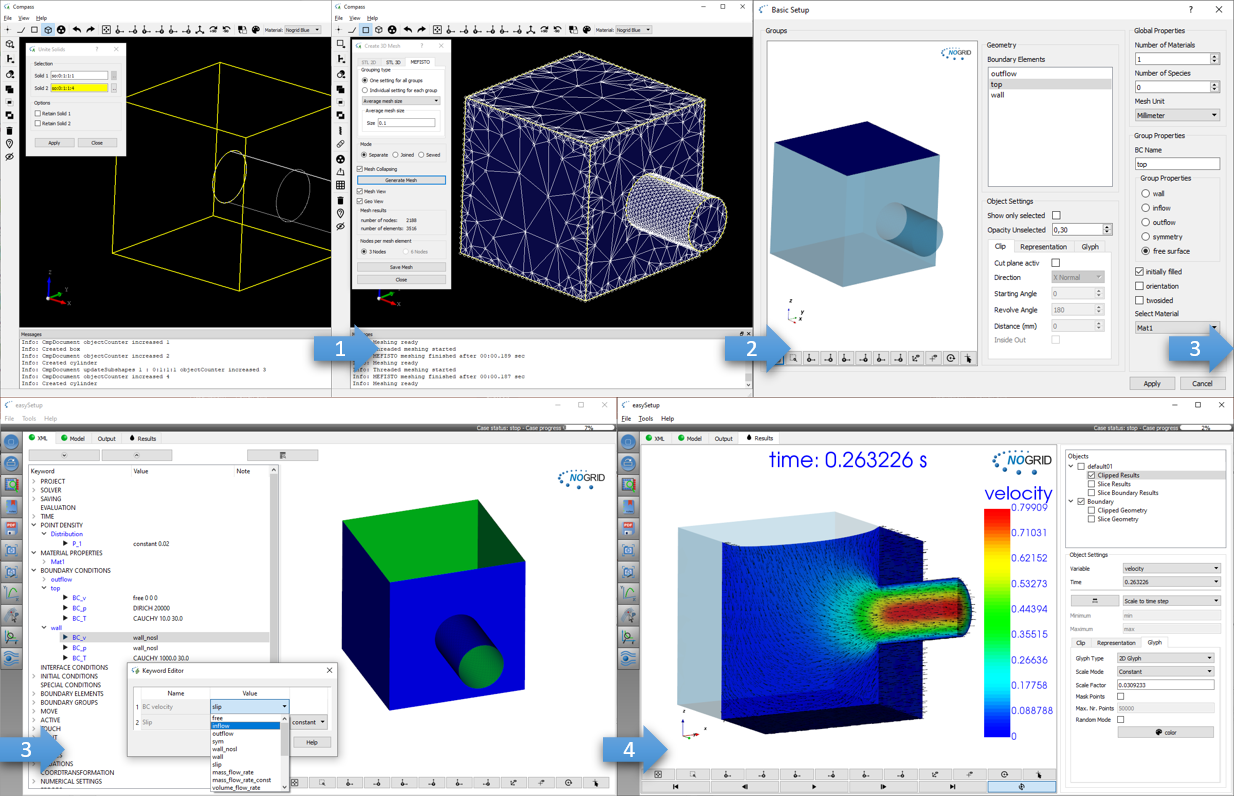
Steps from geometry generation to simulation results
TRAINING
Our two-day training courses teach participants how to set up, run and evaluate simulations efficiently with NOGRID CFD software. The courses include practical guidance for handling different types of simulation cases.
For more details please refer to Training Courses →
Technical Support
Professional support is available from the beginning of your work with NOGRID. Our technical team assists users by telephone and email with software operation, case setup and simulation-related questions.
For more details please refer to Software Support →
Simulation Service
When internal time, expertise or resources are limited, NOGRID can support your project with individual numerical simulation services. Our engineers develop and evaluate CFD models based on the specific requirements of your application.
For more details please refer to Software Support →